Follow the path of Santa around the world.
Ho ho ho! See Santa go - TODAY Holiday Guide - MSNBC.com

http://jasan1.spaces.live.com/


Follow the path of Santa around the world.
Ho ho ho! See Santa go - TODAY Holiday Guide - MSNBC.com
http://jasan1.spaces.live.com/
Christmas is one of the most important festivals of Christianity, along with Easter and Pentecost, which celebrates the birth of Jesus Christ in Bethlehem. This feast is celebrated on December 25 by the Catholic Church, the Anglican Church, and some other Protestant Churches and the Romanian Orthodox Church, and Jan. 7 in other Orthodox churches, as they did not accept the reforms made to the Julian calendar, to spend our current schedule, called the Gregorian. English speakers use the word Christmas, which means “mass of the Christ.” In some Germanic languages, such as German, the holiday is called Weihnachten, which means “night of blessing.” The festivities of Christmas are proposed, as its name suggests, celebrate the nativity (or birth) of Jesus of Nazareth in this world. More about Christmas
Currently, Christmas is a celebration more profane than religious. It's time for big business and exchanging gifts, meetings and family dinner’s. In the West celebrated the Rooster's Mass in churches and cathedrals. In Latin America, rooted in Catholic tradition, especially the celebrated Christmas Eve (December 24) with a family dinner to be prepared for a variety of dishes, desserts and traditional beverages. It is also custom to attend the Rooster's Mass and holding with fireworks. In Mexico, Christmas Eve is the culmination of a celebration that lasts nine days which is called "las Posadas". They start on December 16 and commemorating the journey of Mary and Joseph's search for shelter before the birth of Jesus. More about “las Posadas”
Traditional elements of Christmas
v Christmas Tree: The tradition of adorning the Christmas tree seems that began in
v The Christmas Dinner: Consists of a feast at , in honor of the birth of Christ, which took place at that time, so similar to the Jewish feast of Passover. Traditionally we eat turkey, cod and other dishes, depending on the venue or the traditions of the family.
v Christmas Nativity: Consist of the representation of the birth of Jesus, through a model of
v Crown Advent: It is a crown made based branches of cypress or pine tied with a red ribbon in which are placed four candles are usually red which marked the four Sundays of Advent before Christmas Day.
v The carols: There are songs or songs alluding to the birth of Christ or the Holy Family. Sing and hear carols
v Flower of Christmas Eve: A flower of Mexican origin for decorative use.
v The
v The Piñatas: It consists of an earthenware pot decorated with picks and chopped paper or cardboard figures decorated with colored paper, both filled with candy, fruit and sometimes toys and confetti, which breaks in each of the days of Posadas.
Links of interest
Apart from the Christian origins of Christmas, this festival has been mixing its religious character in the tradition of family life, largely due to the popularity of this celebration and marketing.
It is from the nineteenth century when Christmas starts to take hold with the character it has today, because in this century became popular the habit of exchanging gifts, was created to Santa Claus and Christmas cards. Habits that over time the marketing (especially American) would use Christmas to expand the world by giving a character other than religious, and with topics that have little or nothing to do with the traditional Christmas celebration. Send free Christmas cards
sourc
es:"Navidad." Wikipedia, La enciclopedia libre. 9 dic 2008, . 10 dic 2008, <http://es.wikipedia.org/w/index.php?title=Navidad&oldid=22358410>.
“Que es la Navidad?.”Espacio de Memo. 10 dic 2008 http://jasan1spanish.spaces.live.com/blog/cns!49BF390D536D7A69!345.entry
“Vamos! a romper piñata”.Espacio de Memo. 10 dic 2008 http://jasan1spanish.spaces.live.com/blog/cns!49BF390D536D7A69!351.entry
“That it is Christmas?”Jasan’s Life. 10 dic.2008
http://jasan1.spaces.live.com/blog/cns!FCE4363F5CFE3E4C!574.entry
La Navidad es una de las fiestas más importantes del Cristianismo, junto con la Pascua y Pentecostés, que celebra el nacimiento de Jesucristo en Belén. Esta fiesta se celebra el 25 de diciembre por la Iglesia Católica, la Iglesia Anglicana, algunas otras Iglesias protestantes y la Iglesia Ortodoxa Rumana; y el 7 de enero en otras Iglesias Ortodoxas, ya que no aceptaron la reforma hecha al calendario juliano, para pasar a nuestro calendario actual, llamado gregoriano. Los angloparlantes utilizan el término Christmas, cuyo significado es ‘misa (mass) de Cristo’. En algunas lenguas germánicas, como el alemán, la fiesta se denomina Weihnachten, que significa ‘noche de bendición’. Las fiestas de la Navidad se proponen, como su nombre indica, celebrar la natividad (o sea, el nacimiento) de Jesús de Nazaret en este Mundo. Mas acerca de la Navidad
Actualmente, la Navidad es una fiesta más profana que religiosa. Es tiempo de gran actividad comercial e intercambio de regalos, reuniones y comidas familiares. En Occidente se celebra la Misa de gallo en iglesias y catedr

q Arbol de Navidad: La tradición de adornar el árbol navideño parece que se inició en Alemania y Escandinavia en los siglos XVI y XVII, extendiéndose posteriormente a otros países europeos. consiste en un árbol de conífera adornado con esferas de colores, cintas brillantes, estrellas, luces etc.
q La Cena de Navidad: Consiste en un banquete a medianoche, en honor del nacimiento de Cristo que tuvo lugar a esa hora; de manera parecida al banquete judío del Pésaj. Tradicionalmente se come pavo, bacalao y otros platillos, dependiendo del lugar en que se celebre o las tradiciones de la familia.
q Nacimiento navideño: Consisten en la representación del nacimiento de Jesús, mediante una maqueta de Belén y sus alrededores, en la que las figuras principales son el establo en donde nació Jesús, la Sagrada Familia, los animales y los pastores, también los 3 reyes magos y una estrella con una estela que también suele colocarse en lo alto del árbol de Navidad. Mas acerca de Nacimiento navideño
q La Corona de Adviento: Es una corona hecha a base de ramas de ciprés o pino atada con un listón rojo en la cual se colocan cuatro velas por lo general de color rojo las cuales marcan los cuatro domingos de adviento anteriores al día de Navidad.
q Los Villancicos: Son canciones o cantos alusivos al nacimiento de Cristo o a la Sagrada Familia. Ver y escuchar villancicos
q La Flor de Nochebuena: es una flor de origen mexicano de uso decorativo de las fiestas decembrinas.
q Las Posadas: Son una serie de fiestas populares que recuerdan el trayecto de san José y la Virgen María para llegar a Belén. Estas celebraciones tienen lugar del 16 al 24 de diciembre en Latinoamérica. Mas acerca de Las Posadas
q Las Piñatas: Consiste en una olla de barro adornada con picos y papel picado o figuras de cartón adornadas con papel picado de colores, ambas rellenas de dulces, fruta y en ocasiones juguetes y confeti, que se rompen en cada uno de los días de las Posadas.

Historia de la Tarjeta navideña
Aparte del origen cristiano de la Navidad, esta fiesta ha ido mezclando su carácter religioso con la tradición de convivencia familiar, debido en gran medida a la popularidad de esta celebración y a la mercadotecnia.
Es desde el siglo XIX cuando la Navidad empieza a
 afianzarse con el carácter que tiene hoy día, pues en ese siglo se popularizó la costumbre del intercambio de regalos; se creó a Santa Claus y regalar tarjetas de Navidad. Costumbres que con el tiempo la mercadotecnia (en especial la norteamericana) aprovecharía para expander la Navidad por el mundo dándole un carácter distinto al religioso, y con temas que poco o nada tienen que ver con la tradicional celebración navideña. Enviar tarjetas de navidad
 Fuentes:
"Navidad." Wikipedia, La enciclopedia libre. 9 dic 2008, . 10 dic 2008, <http://es.wikipedia.org/w/index.php?title=Navidad&oldid=22358410>.
“Que es la Navidad?.”Espacio de Memo. 10 dic 2008 http://jasan1spanish.spaces.live.com/blog/cns!49BF390D536D7A69!345.entry
“Vamos! a romper piñata”.Espacio de Memo. 10 dic 2008 http://jasan1spanish.spaces.live.com/blog/cns!49BF390D536D7A69!351.entry
http://jasan1spanish.spaces.live.com

Acquired immune deficiency syndrome or acquired immunodeficiency syndrome (AIDS) is a set of symptoms and infections resulting from the damage to the human immune system caused by the human immunodeficiency virus (HIV). This condition progressively reduces the effectiveness of the immune system and leaves individuals susceptible to opportunistic infections and tumors. Learn more about AIDS
More about AIDS
 http://jasan1.spaces.live.com/
sources: http://en.wikipedia.org/wiki/AIDS

-George Washington, leader of the revolutionary forces in the American Revolutionary War, proclaimed a Thanksgiving in December 1777 as a victory celebration honoring the defeat of the British at Saratoga. More about Thanksgiving day
-In the middle of the American Civil War, President Abraham Lincoln, proclaimed a national Thanksgiving Day, to be celebrated on the final Thursday in November 1863.
-Since 1863, Thanksgiving has been observed annually in the United States. -In 1939, November had five Thursdays that year President Franklin D. Roosevelt declared the fourth Thursday as Thanksgiving rather than the fifth one.

-In 1941 The U.S. Congress passed a bill requiring that Thanksgiving be observed annually on the fourth Thursday of November.
-Since 1947, or possibly earlier, the National Turkey Federation has presented the President of the United States with one live turkey and two dressed turkeys, in a ceremony known as the National Thanksgiving Turkey Presentation. Thanksgiving at The White House
-While it is commonly held that this pardoning tradition began with Harry Truman in 1947, the Truman Library has been unable to find any evidence for this.
-In more recent years, two turkeys have been pardoned, in case the original turkey becomes unavailable for presidential pardoning. See Turkey Facts
-Since 2003 the public has been invited to vote for the two turkeys' names.
-Since 2005, the two turkeys have been flown first class on United Airlines from Washington, D.C. to the Los Angeles area where they become the Grand Marshals of Disneyland's annual Thanksgiving Day parade
-Since 1970, a group of Native Americans and other assorted protesters (mostly of progressive political persuasion) have held a National Day of Mourning protest on Thanksgiving at Plymouth Rock in Plymouth, Massachusetts in the name of social equality and in honor of political prisoners.
-Baked or roasted turkey is usually the featured item on any Thanksgiving feast table More about Thanksgiving meals
http://jasan1.spaces.live.com/
Sources: http://www.pilgrimhall.org/plgrmhll.htm
http://jasan1.spaces.live.com/blog/cns!FCE4363F5CFE3E4C!2041.entry
The most-used language on the Internet is English. Although the total number of native English speakers in the world is about 322 million, English is spoken as a second language by up to 1.2 billion people around the world. They make their contributions to the Internet in their own language as well as in English.
Chinese is the most spoken native language on Earth, and the second language on the Internet. The Chinese population online is increasing at a high rate; this is expected to have a great impact on the Internet in the near future. See list for Internet users per country
Check this out:
Notably absent from the table above is Hindi, the most widely spoken language in India. This is due to the high numbers of English educated Indians. Virtually all Indian colleges and universities teach in English. English, along with Hindi, are the two official languages of India. The Indian population online is also increasing at a high rate; this is also expected to have a great impact on the Internet in the near future. Learn more about Internet
Sources:
http://en.wikipedia.org/wiki/Global_Internet_usage
http://www.internetworldstats.com/
Thanksgiving, or Thanksgiving Day, celebrated on the fourth Thursday in November, at the end of the harvest season, is an annual American Federal holiday to express thanks for one's material and spiritual possessions. The period from Thanksgiving Day to New Year's Day often is called the holiday season. Most people celebrate by gathering at home with family or friends for a holiday feast. Read more about Thanksgiving
The first thanksgiving”, 1621the Pilgrims at Plymouth

"our harvest being gotten in, our governor sent four men on fowling, that so we might after a special manner rejoice together, after we had gathered the fruits of our labors; they four in one day killed as much fowl, as with a little help beside, served the Company almost a week, at which time amongst other Recreations, we exercised our Arms, many of the Indians coming amongst us, and amongst the rest their greatest king Massasoit, with some ninety men, whom for three days we entertained and feasted, and they went out and killed five Deer, which they brought to the Plantation and bestowed on our Governor, and upon the Captain and others. And although it be not always so plentiful, as it was at this time with us, yet by the goodness of God, we are so far from want, that we often wish you partakers of our plenty." -Edward Winslow, Mourt's Relation
"They began now to gather in the small harvest they had, and to fit up their houses and dwellings against winter, being all well recovered in health and strength and had all things in good plenty. For as some were thus employed in affairs abroad, others were exercised in fishing, about cod and bass
and other fish, of which they took good store, of which every family had their portion. All the summer there was no want; and now began to come in store of fowl, as winter approached, of which this place did abound when they came first (but afterward decreased by degrees). And besides waterfowl there was great store of wild turkeys, of which they took many, besides venison, etc. Besides, they had about a peck of meal a week to a person, or now since harvest, Indian corn to that proportion. Which made many afterwards write so largely of their plenty here to their friends in England, which were not feigned but true reports." -William Bradford, Of Plymouth Plantation more about Thanksgiving
During the American Revolutionary War the Continental Congress appointed one or more thanksgiving days each year, each time recommending to the executives of the various states the observance of these days in their states. The First National Proclamation of Thanksgiving was given by the Continental Congress in 1777.
Sources:
-Thanksgiving (United States)
http://en.wikipedia.org/wiki/Thanksgiving_(United_States)
-Pilgrim Hall Museum
http://www.pilgrimhall.org/plgrmhll.htm
Check out these sites talking about Thanksgiving:
With 22 million people living and working in southern California, a major earthquake in the region could cause an unprecedented catastrophe. What we do now, before a big earthquake, will determine what our lives will be like after. With earthquakes an inevitable part of southern California’s future, Californians must act quickly to ensure that disasters do not become catastrophes. With this in mind, the Earthquake Country Alliance has organized the Great Southern California ShakeOut, a week of special events featuring a massive earthquake drill at 10 AM on November 13, 2008. 
The ShakeOut drill centers on the ShakeOut Earthquake Scenario, a realistic portrayal of what could happen in a major earthquake on the southern end of the San Andreas Fault. Created by over 300 experts led by Dr. Lucy Jones of the U.S. Geological Survey, the scenario outlines a hypothetical 7.8 magnitude earthquake originating near the Salton Sea, which would have the potential to devastate the region.
While earthquakes cannot be predicted or prevented, steps can be taken to prepare in order to make a difference in how our lives will be after an earthquake. Secure your space by strapping top-heavy furniture, water heaters, and other items to walls or tabletops. Strengthen your buildings walls and foundation if necessary. Of course, it is important to have resources to protect yourself and others should assistance be slow in arriving. Three to 14 days worth of water for each person, non-perishable food, and a fire extinguisher, among other supplies, can be valuable resources to have stored and ready for such a disaster.
With a goal of at least 5 million participants, the ShakeOut drill will be the largest in U.S. history. To participate, go to www.ShakeOut.org/register and pledge your family, school, business, or organization’s participation in the drill. Registered participants will receive information on how to plan their drill, connect with other participants, and encourage a dialogue with others about earthquake preparedness. There are many ways to take part, but at the least participants should Drop, Cover, and Hold On at 10 A.M. on November 13. It all begins with registering, which is free and open to everyone.
For more information, visit www.ShakeOut.org and be sure to visit the official ShakeOut Blog at greatsocalshakeout.blogspot.com.
The November 20 is celebrated 98 anniversary of the Mexican Revolution, seen as the first social revolution of the twentieth century, and Mexicans are preparing for the commemoration of the centenary of the beginning of this in 2010. The revolutionary struggle has as antecedent the interview in March 1908 that then-President Porfirio Díaz with almost thirty years in power gave the American journalist James Creelman, Díaz In this interview he said that the Mexican people and was fit for democracy, and he promised to retire to private life once they complete their term of government in 1910:
"I waited patiently on the day the Mexican people were prepared to select and change their government in every election without dan
ger of armed revolutions, without compromising the national credit and without impeding the progress of the country. I think that day has arrived. If in the republic, he added, were to arise an opposition party, it would look like a blessing and not as an evil, and whether that party to develop power, not to exploit, but to lead, I would welcome it, and I would support enshrine the successful inauguration of a fully democratic government ... "
The news filled with optimism to many people, who immediately began to organize themselves to participate in the elections of 1910. Several political parties emerged, including "National Party Antirreeleccionista" this was founded on May 22, 1909, with the initiative of Francisco I. Madero and Emilio Vazquez Gomez, in Mexico City. Another of them both with the Democratic Party trend revolutionary, while the trend Porfirista groups, such as the National Party and the Party Porfirista Scientific opted to reorganize to better act before the imminence of an election campaign
Madero had already been made famous by then, due to the publication of his book entitled "Presidential Succession in 1910", which did a study of the political situation in Mexico, with some revolutionary approach, this was presented as a candidate for Presidency of the Republic in the Independent National Convention, held in Mexico City in April 1910. The conventions elaborated a program that would serve as a banner of struggle, and in which the principles of "no reelection" of the President and Governors, and "effective suffrage," were essential.
In his capacity as president of the Republic, Francisco I. Madero made a new tour policy for the Republic, arousing great enthusiasm for their approaches of opposition to the regime of Porfirio Díaz, aimed to achieve this not by violence but by the citizens' participation in the elections. The government was alarmed at the sight of such a situation and seized a Madero, accusing him of crimes and outrages upon the authority of attempted rebellion in Monterrey, then driving to San Luis Potosi to further the process, their defense was able to leave free on bail, on condition that they not leave the city. In this tense atmosphere the elections took place in mid-1910, in which there were several irregularities and elected Porfirio Díaz and Ramon Corral, who occupy the posts of president and vice president respectively for the period 1910-1914.
Realizing that a peaceful solution was impossible, Francisco I. Madero, ready to launch an armed uprising, escaped from San Luis Potosi to San Antonio, Texas, where he proclaimed the Plan de San Luis, on October 5, 1910, which stated:
“Echoing the national will declare illegal the last election and therefore leaving the Republic without legitimate rulers, temporarily assume the presidency of the republic, while the people appointed under the law to their rulers”
He then stated in Article 7 of that plan, "On November 20, from six in the afternoon onwards, all citizens of the Republic shall take up arms to yield power to the authorities that govern us today." That day, however, did not happen virtually nothing, except the uprising on the part of Toribio Ortega and a group of 60 warlords in Knife Stopped, Chihuahua on June 14 and in Puebla on June 18. The rest of the outbreaks rebels erupted in the following days.
The Mexican Revolution officially ended with the promulgation of a new constitution in 1917, although outbreaks of violence would continue until the end of the decade of the twenties. The movement had a great impact on the business workers, agricultural anarchists at the international level since the Constitution of the United Mexican States, 1917 was the first in the world to recognize the social guarantees and labor rights groups. More….
Fuentes:http://es.wikipedia.org/wiki/Revoluci%C3%B3n_Mexicana
http://www.elbalero.gob.mx/historia/html/rev/antecede.html
http://jasan1.spaces.live.com/blog/cns!FCE4363F5CFE3E4C!543.entry
http://jasan1.spaces.live.com/
Versión en Español/ Spanish version


The celebration of the Day of the Dead in Mexico, takes place on November 1st and 2nd, as each year the Mexicans are preparing to celebrate their loved it and went and that according to religious belief and popular to be returned once more with their loved ones, that will be waiting with altars adorned with flowers and food to the deceased that liked to enjoy life. For the Mexican live with death is an act of faith and belief in it will feel again the presence of the dead among the living, contrary to what we believe to be Mexican likes this coexistence and even mocks her.
"For the inhabitant of New York, Pa
ris or London, death is never word that is pronounced because it burns the lips. The Mexican, however, frequents, mockery, the caresses, sleeps with it, celebrates, is one of his favorite toys and his love more permanent. True, there are perhaps in their attitude as much fear in the other, but at least not hide or hide; contemplates the face to face with patience, disdain or irony. "
Octavio Paz
So we can see in the engravings of Jose Guadalupe Posada, a clear demonstration of this strange relationship with death and the people who welcomed making and eating the sugar “calaveritas” and “pan de muerto”, to laugh at the death of created literature skulls, where versed in highlighting strengths and weaknesses of the living.
“¡Ay muerte, no te me acerques, que estoy temblando de miedo!”
Each of the current population of Mexico has traditions and way of expressing their concept of the cult of death, these activities vary according to region, the customs of the locality, and the socioeconomic level of it.
The Indian Feast Day of the Dead has been proclaimed Masterpiece of the Oral and Intangible Heritage of Humanity. This recognition is awarded by the Organization of the United Nations Educational, Scientific and Cultural Organization (UNESCO). More...
http://www.cdi.gob.mx/index.php?id_seccion=420
http://culturaspopulareseindigenas.gob.mx/noticias_muertos.htm
http://sepiensa.org.mx/contenidos/muertos/muertos.htm
http://jasan1.spaces.live.com/blog/cns!FCE4363F5CFE3E4C!526.entry
Spanish version/Versión en español
 La celebración del día de muertos en México, tiene lugar el día 1 y 2 de noviembre, como cada año los mexicanos se preparan para celebrar a sus seres que ya se fueron y que según la creencia religiosa y popular regresaran para estar una vez mas con sus seres queridos, que los estarán esperando con altares adornados con flores y comidas que al fallecido le gustaba disfrutar en vida. Para el mexicano el convivir con la muerte es un acto de fe y creencia en el que se sentirá nuevamente la presencia de los muertos entre los vivos, contrario a lo que se pueda creer al mexicano le gusta esta convivencia y hasta se burla de ella.
“Para el habitante de Nueva York, Paris o Londres, la
muerte es palabra que jamás se pronuncia porque quema los labios. El mexicano, en cambio, la frecuenta, la burla, la acaricia, duerme con ella, la festeja, es uno de sus juguetes favoritos y su amor más permanente. Cierto, en su actitud hay quizá tanto miedo como en la de los otros; mas al menos no se esconde ni la esconde; la contempla cara a cara con paciencia, desdén o ironía”.
Octavio Paz
Así podemos ver en los grabados de José Guadalupe Posada, una clara muestra de esta extraña relación con la muerte y a la gente que celebra haciendo y comiendo las calaveritas de azúcar y el pan de muerto, para reírnos de la muerte creamos calaveras literarias, en donde en forma versada se resaltan virtudes y defectos de los vivos.
Cada una de las poblaciones del México actual cuenta con tradiciones y forma de expresar su concepción del culto a la muerte, estas actividades varían de acuerdo con la región, las costumbres de la localidad, y el nivel socioeconómico de la misma.
La UNESCO declaró en al año 2003 a la Festividad Indígena de Día de Muertos como “ Obra Maestra del Patrimonio Oral e Intangible de la Humanidad”. Mas...
http://www.cdi.gob.mx/index.php?id_seccion=420
http://culturaspopulareseindigenas.gob.mx/noticias_muertos.htm
http://sepiensa.org.mx/contenidos/muertos/muertos.htm
Version en Ingles/English version
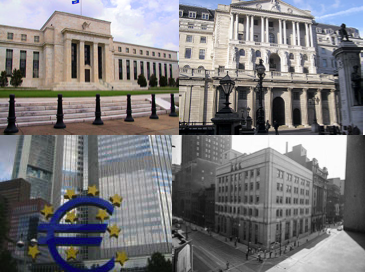 In an effort to reduce the effect of the ongoing financial crisis, six central banks worldwide have reduced their interest rates by 0.5% in an unexpected move which took place today. The banks involved in the deal are the Bank of Canada, the Bank of England, the European Central Bank, the Federal Reserve, Sveriges Riksbank, and the Swiss National Bank. more...
source: http://en.wikinews.org/wiki/Central_banks_worldwide_cut_interest_rates

M any countries in the New World and elsewhere celebrate the anniversary of Christopher Columbus's arrival in the Americas, which occurred on October 12, 1492. The day is celebrated as Columbus Day in the United States, as Día de la Raza (Day of the Race) in Argentina, Chile, Costa Rica, Ecuador, Honduras, Mexico, and Uruguay , as Día de las Culturas (Day of the Cultures) in Costa Rica, as Discovery Day in The Bahamas and Columbia, as Día de la Hispanidad (Hispanic Day) and National Day in Spain, and as Día de la Resistencia Indígena (Day of Indigenous Resistance) in Venezuela.
In the fifteenth century, an obscure Italian seafarer named Christopher Columbus became convinced that it was possible to reach the East from Europe by sailing westward across the Atlantic and that this route would be shorter than traveling around Africa; he underestimated the size of the Earth and overestimated the size and eastward extension of Asia. After eight years of negotiations, he convinced Queen Isabella of Spain to support his enterprise. He finally set out in three small ships and, on October 12th, 1492. Although Christopher Columbus was perhaps not the first to discover America, as has so often been claimed, he was the one to bring about the first real contact and interaction between Renaissance Europe and the American continent with its various civilizations; and that has shaped and changed world history in countless ways. Over 500 years later, this date is still celebrated, lamented, and debated.
Since 1971, the holiday has been commemorated in the U.S. on the second Monday in October It is generally observed today by banks, the bond market, the US Postal Service and other federal agencies, most state government offices, and many school districts; however, most businesses and stock exchanges remain open.
Sources: http://worldculturenet.com/2006/10/09/columbus-day-and-dia-de-la-raza/
http://zedillo.presidencia.gob.mx/welcome/PAGES/culture/note_12oct.html
http://en.wikipedia.org/wiki/D%C3%ADa_de_la_Raza
Spanish version/Versión en español


